Showing posts with label Adult Non-Fiction. Show all posts

Wednesday, October 12, 2011

Waiting on Wednesday (11)

 
"Waiting on" Wednesday is a weekly chance for bloggers to share books we can't wait to get our hands on.  
It's hosted by Jill from Breaking The Spine. 

Available in Paperback January 3, 2012:


Tyndale:  The Man Who Gave God an English Voice
  by David Teems


  • Publisher: Thomas Nelson, Inc.
  • Format: Paperback, 336pp
  • Age Range: Adult
  • ISBN-13: 9781595552211

Synopsis from BN.com:

The English Bible was born in defiance. It was also born in exile, in flight, in a kind of exodus. And these are the very elements that empowered William Tyndale in his bid to bring the English Scripture to the common citizen. Being "a stranger in a strange land," the very homesickness he struggled with, gave life to the words of Jesus, Paul, and to the wandering Moses. Tyndale's efforts ultimately cost him his life, a price he was certain he would have to pay. But his contribution to English spirituality is measureless.
Even five centuries after his death at the stake, Tyndale's presence looms wherever English is spoken. His single word innovations, such as "Passover," "beautiful," and "atonement" allowed the common man to more fully understand God's blessings and promises. His natural lyricism shines in phrases like "Let not your hearts be troubled," and "for thine is the kingdom and the power and the glory." Every time we say the Lord's Prayer as it is written in the King James Bible or use the word "love" as it is written in 1 Corinthians 13 or bless others with "The Lord bless thee and keep thee, the Lord make his face to shine upon thee," we are reminded of the rich bounty Tyndale has given us.
Although Tyndale has been somewhat elusive to his biographers, Teems brings wit and wisdom to the story of the man known as the "architect of the English language," the English Paul who defied a kingdom and a tyrannical church to introduce God to the plowboy.
I can never get over that the Bible used to be available in only Greek or Latin.  I can't fathom sitting in those old Masses not knowing what was being spoken unless you were wealthy or privileged enough to be educated.  I'm so thankful for the Reformation and the efforts of the men who brought religion to the masses.

This looks like an informative and enjoyable read!


That's what I'm waiting on! Now how 'bout you?


Wednesday, September 14, 2011

Waiting on Wednesday (10)

 
"Waiting on" Wednesday is a weekly chance for bloggers to share books we can't wait to get our hands on.  
It's hosted by Jill from Breaking The Spine. 

Available in Hardcover October 31, 2011:


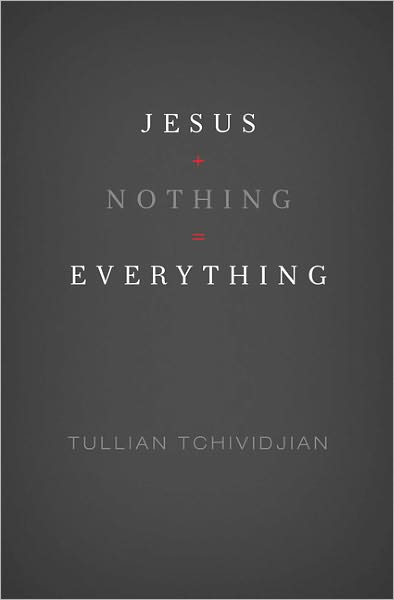
Jesus + Nothing = Everything by Tullian Tchividjian


  • Publisher: Crossway Books
  • Format: Hardcover, 224pp
  • Age Range: Adult
  • ISBN-13: 9781433507786

Synopsis From Crossway.org:
Jesus + Nothing = Everything is the equation that Tullian Tchividjian took away from a year of great trial and turmoil. He describes the bitter divisions that soured the beginning of his pastorate at Coral Ridge Presbyterian Church and the personal anchor that he found in the overwhelming power of the gospel. The book of Colossians forms the basis of Tchividjian’s call for Christians to rediscover the gospel and continually reorient their lives around Jesus and only Jesus.
Tchividjian insists that many who assume they understand the gospel fail to actually apply its riches to their lives. He takes particular aim at self-righteousness, which motivates moral behavior by fear and guilt. In contrast, the gospel of grace, with the radical freedom that it brings, provides the only sustainable motivation for Christians. This book delves into the profound theological truths of the gospel, yet the message is intensely practical—Tchividjian sounds the call for believers to lean hard on Christ in every area of every day.
I don't know about you, but I find that every now and then, I need to take a break from fiction and dive into some non-fiction.  I've been looking forward to this book since the day I found out it was coming! In fact, I had even pre-ordered it at Borders many months ago before the chain closed.  So, I was saddened when they cancelled my order as the liquidation process began.  But I digress....

Tullian Tchividjian is a Pastor at Coral Ridge Presbyterian Church, and is one of Billy Graham's grandsons.  He is charismatic and contemporary in his approach to the pulpit.  There was even fuss from some over his refusal to wear the traditional Pastoral robes.  His own life story is one that includes rebellion, and he'll be the first to tell you that he's a Prodigal and a sinner in need of grace.  But he'll  remind you in this book (and even on Twitter!) that we all need grace.  But only grace.  We shouldn't beat ourselves up trying to be perfect to win God's favor.  Nor do we need to.  If we look at what grace really means, we'll find freedom and live more abundantly.

I can't wait to read this book! I follow Pastor Tullian on Twitter and have seen some of his sermons on this topic, so I know it will be rewarding.

That's what I'm waiting on! Now how 'bout you?
 

Sunday, July 10, 2011

Read Love Reviews: Decision Points

Decision Points by George W. Bush

Pub. Date: November 2010
Publisher: Crown Publishers
Format: Hardback, 497pp
Age Range:Adult
ISBN-13: 9780307590619


My Review:


In March 2004, President George W. Bush’s daughter Jenna, in her final year at college, sent him a heartfelt letter asking that he consider allowing her to help him campaign for re-election.  She wrote:
"I hate hearing lies about you.  I hate when people criticize you. I hate that everybody can’t see the person I love and respect, the person that I hope I someday will be like."
I feel that Decision Points accomplishes what Jenna hoped to do in the campaign.  The book does a good job of showing us the man behind the presidential desk.  The man who was faced with tough decisions and did his best to make and stand behind them, stick with them as needed, or change course if necessary.  It’s easy to be on the outside looking in and criticize someone.  In the case of a president, many are so much more tempted to look for faults and mistakes. This book allows the reader a glimpse into the Office of the Presidency.  Arranging the book into chapters focused on the most pivotal decision points he faced as president, George Bush allows us to gain insight into both the decisions he made and also the thought, counsel, and information that led to his choices.  At times, we also get a peek at the emotions the president felt as a result of those decisions. While only other presidents can fully understand the privileges and burdens of the job, President Bush gives the reader the closest experience to walking a mile in his presidential shoes.

The justifications he gives for his decisions do not read like an attempt to defend himself or persuade the reader.  Instead, President Bush outlines the chronology of events surrounding each decision  and presents the facts (which were often unknown to the public at the time), leaving readers free to make their own judgments.  Absent in his memoir is any hint of resentment.  He also steers clear of political name-calling or finger-pointing, and at times even admits fault or takes the responsibility himself.

George W. Bush was perhaps more maligned than any other American president.  And the attacks were not limited to his policies or politics, they were personal.  One world leader compared him to Adolf Hitler.  A grieving mother of a serviceman told him, "You are as big a terrorist as Osama bin Laden."  President Bush speaks thusly of the woman’s harsh words: “If expressing her anger helped ease her pain, that was fine with me.”  Just as he stood quietly and took that angry verbal lashing, he endured all kinds of personal assaults on top of an already burdensome and taxing eight years in office.  He did not have the option of walking away, withholding judgment, or passing the buck.  A president’s job never ends, and as Bush’s time in the White House drew to a close, adversity never lessened. His final months were just as tough as his first year in office.  So, if in writing his book he were to show bitterness or ask for a little pity, one certainly couldn’t fault him.  However, he never did so while in office, and he did not do so in his book.  As he says, “I didn’t feel sorry for myself. . . Self-pity is a pathetic quality in a leader.” Although his family, especially his daughters, couldn’t help but take the harsh criticisms against him and his character to heart, Bush never personalized the attacks, nor did he allow public opinion or political posturing to steer his decision-making or exert undue force on his actions.

Decision Points is not a strict biography.  Though in the early pages he talks about his family and his career leading up to the presidency, its main focus is on Bush’s eight years in the White House.  Because of its conversational tone, the book is very readable and accessible. Several things stood out for me:    
  • Bush’s love for his family – his parents, brothers and sister, Laura, and the twins.
Bush is at his most candid when speaking about family.  He freely shares letters from his father and daughter, as well as private moments like the death of his sister Robin and driving his mother to the hospital after a miscarriage.
  • Moments of humor:  
In 1993, while  running the Houston Marathon, Bush passed his parents’ church just as the service let out.  As their son went by, his father cried encouragingly, “That’s my boy!”  His mother, on the other hand, shouted, “Keep moving, George! There are some fat people ahead of you!”
When visiting the Queen of England, President Bush asked about her dogs.  The corgis, who were soon brought out, were polite and well-behaved.  He immediately worried about the potential reciprocal meeting in America and the requisite canine introduction there.  He silently hoped that Barney would be just as well-mannered and "would not bark for Scottish independence."
  • The humanity of George Bush: 
The chapter titled Lazarus Effect was one of the easiest and most rewarding in the book.  Here, Bush chronicles and explains his decisions that increased America’s contributions in the global fight against AIDS from the previous administration’s $500 million a year to eventually $15 billion over the period from 2003 to 2008. The fight was carried to fourteen of the world’s poorest and sickest nations, twelve of which were in Africa.  In 2007, Bush called on Congress to reaffirm the expiring initiative and actually doubled commitment to $30 billion over the next five years.  We read about trips that George and Laura took to Africa, and learn how these experiences and humanitarian efforts shaped the futures of daughters Jenna and Barbara as well.
When President Bush made personnel changes, rather than just remove people from their duties, like generals in Iraq whose strategies were not working, he would reward their service by finding promotion for them elsewhere.  Changes in staff, such as the decision not to re-nominate General Pete Pace as Chairman of the Joint Chiefs, sometimes pained him.  Though he sought to save his friend public criticism and humiliation, he still expressed remorse for letting him go:  “I ached for Pete and his family.  When I presented him with a well-deserved Presidential Medal of Freedom in 2008, it only partly assuaged my regret.”
  • The emotional burden of U.S. military actions in Iraq and Afghanistan:
After he ordered the troops to Iraq, he took a private walk around the South Lawn, in silent prayer and reflection.  He felt the decision was the right thing to do, but that didn’t mean it was easy.  He is an emotional, compassionate man.  Each morning, he would read the newspapers and the overnight reports he received from the Situation room.  He refers to these reports as the “blue sheets.”  One section of the blue sheet listed the number, cause, and location of American casualties in each conflict.  President Bush writes about reading the reports: “When I received a blue sheet, I would circle the casualty figure with my pen, pause, and reflect on each individual loss.”  This was clearly hard on him.  One way he showed his gratitude for the service of these brave individuals was to write a letter to the family of each fallen soldier.  He wrote a total of over 5,000. He also met personally with about 550 families of the fallen, made numerous visits to hospitals to visit the wounded, and took a risky secret flight to Iraq in 2003, before the capture of Saddam Hussein, to spend Thanksgiving with the troops.
What the reader sees in Decision Points is a glimpse of the man his daughter Jenna loves,  respects, and admires.  George W. Bush believes in serving a cause greater than himself.  He is a man who did his best, facing the problems and issues dealt him, and, given the knowledge he had at hand, he acted thoughtfully and decisively in order to make what he considered to be the choices that were in the best interest of the country and/or the safety of the American people. For me, these words he spoke during the financial crisis define his guiding philosophy for decision-making during his terms as president: “We don’t have time to worry about politics. Let’s figure out the right thing to do and do it.”